
In short
- Work from your own use: a winter month's kilolitres from your Ekurhuleni bill, times 1,000, divided by 30, is your litres a day.
- Alberton's outages come in three lengths: an overnight pressure drop lasting hours, a burst main that takes most of a day, and bulk supply trouble that has run past a week.
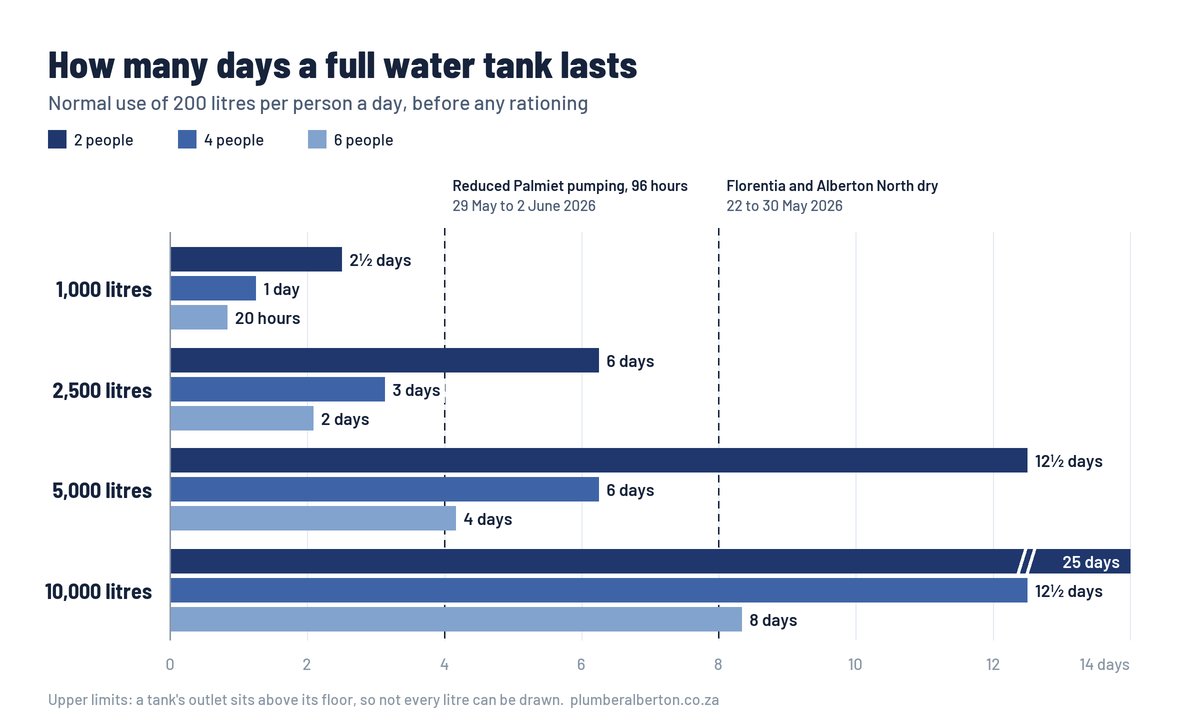
- At normal use, 2,500 litres keeps a four-person home going for about three days and 5,000 litres for about six. Careful use doubles both.
- Almost every tank needs a booster pump for a usable shower, and in Ekurhuleni the pump must draw from the tank, never straight off the municipal pipe.
The right water tank size for an Alberton home comes from two numbers: how many litres the house uses in a day, and how many days the supply is likely to be off or too weak to use. Most sizing advice skips the second. In Alberton it settles the answer, because the town's outages are well recorded and come in very different lengths. This guide covers both the way a plumber in Alberton would, without recommending a make or model: the size comes out the same whichever tank you buy.
Water Tank Size Starts With Your Own Daily Use
Your municipal account already measures it. Ekurhuleni bills water by the kilolitre, which is 1,000 litres, so: kilolitres a month × 1,000 ÷ 30 = litres a day. A four-person house that used 24 kl last month used about 800 litres a day, or 200 litres per person.
- Use a winter bill if you can. Summer accounts carry garden watering and pool top-ups, which a backup tank is rarely asked to supply.
- Check the meter first. With every tap closed it should not move. If it creeps, part of your "use" is a leak, and a leak empties a tank as fast as it runs up the account. Finding the leak comes before buying storage to feed it.
- Decide what the tank must keep running. In an outage most households drop to toilets, short showers, cooking and drinking water.
Two reference points help with outage use. National regulations set basic water supply at a minimum of 25 litres per person per day, a survival figure. The United Nations describes enough water for personal and domestic use as 50 to 100 litres per person per day. The table below uses 100 litres per person as careful use and 200 litres, the bill example, as normal use. Swap in your own figure if your bill says otherwise.
The Outages An Alberton Water Tank Has To Cover
Alberton's water comes from Rand Water through the City of Ekurhuleni's reservoirs, and the recent record shows four patterns.
Overnight: lower pressure, sometimes none
When storage runs low, Ekurhuleni lowers pressure in high-demand areas and closes reservoir outlet valves at night so the reservoirs can refill. The City said so in October 2022, under Rand Water's stage 2 restrictions. In November 2016, Alderman Bruna Haipel told the Alberton Record that the pressure reducing valves across the Alberton reservoir's 27 supply zones, serving Alberton, Thokoza and Eden Park, were set to give one bar at the highest point by day and very low pressure between 22:00 and 05:00. This lasts hours, not days, and a tank refills each day once the pressure returns.
A burst main: most of a day
On 17 November 2022 a major burst in Brackenhurst left the south of Alberton without water for most of the day, with Tinasonke, Brackendowns, Mayberry Park, Albertsdal and Eden Park among the areas hit. Even after the repair, the City said the large network took time to refill and pressurise. Plan on a full day of use, plus some hours of weak pressure.
Rand Water's bulk supply work: days, then recovery
Rand Water's own work reaches Alberton too: a July 2025 emergency valve replacement disrupted Alberton North and South Crest for about six hours from 05:00. The City's notice for 29 May to 17 July 2026 listed Albertsdal, Brackendowns, Brackenhurst, Meyersdal, Raceview, Verwoerdpark, Thokoza, Eden Park and New Redruth among areas that could see low pressure or no water. Its longest phase was up to 96 hours of reduced pumping into the Palmiet system from 29 May to 2 June, and the notice warned that "full recovery of the system may take up to 10 days after completion of work", slowest in high-lying areas and those fed through pumping systems.
Reduced pumping is not the same as dry taps. Pressure comes and goes, and a float valve tops the tank up whenever it does, so the tank stretches further than the arithmetic suggests. Four days of careful use is a sensible target here.
The worst recent case: eight days in Florentia
Florentia and Alberton North were without water from 22 to 30 May 2026. The Alberton Record traced it to three faults at once: a pressure reducing valve problem at the Alberton North reservoir, a major bulk leak near the N12, and a hidden burst on Jacoba Road leaking into a stormwater drain. Eight days is longer than the national basic supply standard allows for: the regulations that set the 25 litre minimum say no consumer should be without supply for more than seven full days a year. A week of careful use is a realistic ceiling for a suburban property.
So the days of cover that matter in Alberton are:
- Less than a day for the overnight pressure regime.
- One day for a burst main and the refill after it.
- About four days, used carefully, for a Rand Water maintenance window.
- Seven to eight days for the worst recent case, and the most worth storing for.
How Many Days Each Water Tank Size Gives A 2, 4 Or 6 Person Home
Divide the tank size by the household's daily use. The table does it at normal use of 200 litres per person a day, with careful use of 100 litres underneath, rounded down to the half day.
| Tank size | 2 people | 4 people | 6 people |
|---|---|---|---|
| 1,000 litres | 2½ days5 days careful | 1 day2½ days careful | 20 hours1½ days careful |
| 2,500 litres | 6 days12½ days careful | 3 days6 days careful | 2 days4 days careful |
| 5,000 litres | 12½ days25 days careful | 6 days12½ days careful | 4 days8 days careful |
| 10,000 litres | 25 days50 days careful | 12½ days25 days careful | 8 days16½ days careful |
Normal use: 200 litres per person a day. Careful use: 100 litres per person a day.
- 1,000 litres covers the overnight drop and a one-day burst for a small household. For four or more people it is an overnight buffer, not an outage tank.
- 2,500 litres takes four people through a day-long burst easily, and through a 96-hour Rand Water window only if they are careful.
- 5,000 litres covers a four-day window at normal use for four people, and an eight-day event like Florentia's if they ration.
- 10,000 litres suits six or more people, if the yard can take it.
Treat the table as an upper limit: the outlet sits a little above the tank floor, so not every litre can be drawn. And a tank that feeds the house all the time only starts an outage full if the inlet keeps up with use, which depends on the pressure at your boundary at that hour.
Fitting The Water Tank Size You Need: Space, Stand Or Pump
Space often narrows the choice before money does. Every 1,000 litres is one cubic metre, so a round tank about two metres tall needs roughly half a square metre of floor per 1,000 litres: 5,000 litres takes a circle about 1.8 metres across. Every litre also weighs a kilogram, so a full 5,000 litre tank puts five tonnes on a level, compacted base or slab that must be wider than the tank. Slimline tanks trade width for length to sit along a wall, and two smaller tanks linked together fit where one large one will not. In an estate such as Meyersdal Eco Estate or Alberante, check the architectural rules on where a tank may stand.
Then the height question. Every metre a tank sits above a tap adds about 0.1 bar, so a tank on a three metre stand gives roughly 0.3 bar at a ground-floor tap, against the one bar the City's own reduced daytime setting aimed for in 2016.
- On a stand, gravity only. No electricity and nothing to wear out, but the pressure suits toilets and an outside tap, not showers. The stand holds a tonne in the air for every 1,000 litres, which in practice limits the tank size.
- On the ground, with a booster pump. Normal pressure at every tap and no practical size limit, but it needs power. That matters here: on 12 August 2026 the Alberton Record reported power outages across parts of Brackenhurst, Brackendowns, Albertsdal, Eden Park, Thokoza South and Alrode South. A bypass to the municipal line keeps the house supplied whenever the City's water is on and the pump is not.
Why A Water Tank Of Any Size Usually Needs A Pump
A tank on the ground has almost no pressure at its outlet. It fills a bucket but will not run a shower. A booster pump draws from the tank and pushes into the house's cold supply at a steady pressure, usually with a small pressure vessel so it does not start and stop with every tap.
The order of connection is set in Ekurhuleni: the City's Water Services By-law says a pump installed to maintain supply may not be connected directly to the municipal network, and its suction pipe must be connected to a storage tank fed from that network. So the supply runs into the tank through a float valve, then tank to pump to house, with a bypass for when the pump is off. Any pressure control valve protecting the geyser stays in the line, so the geyser sees the pressure it is rated for whichever source feeds it.
A pump cannot cure a fault inside the house. A half-closed valve or a corroded pipe still needs finding, which is where water pressure repairs start: a gauge at the meter and one inside, before anything is fitted.
What A Plumber Checks When Fitting Your Water Tank And Pump
When we size and fit a tank and pump set, these are the checks:
- Real daily use, from the bill and the meter, with a leak test first.
- The base and position: level, able to carry the full weight, with room to reach the lid and valves and a short run to where the supply enters the house.
- The inlet: a float valve, a stop valve at the tank, and an inlet that discharges above the overflow level so stored water can never be drawn back into the municipal pipe.
- The overflow: discharging where you will see it, not into a drain, so a stuck float valve shows itself. Ekurhuleni's by-law asks for this and the inlet arrangement.
- The outlet and pump: a stop valve so the pump can be serviced without draining the tank, a non-return valve, and a pump sized to the taps likely to run at once and the height of the house.
- The bypass and the geyser: a bypass for power cuts and pump repairs, with the geyser's pressure control left in place.
- Clean storage: a covered, vermin-proof tank with a screened vent, plumbed so the household uses the stored water every day.
Weak pressure even when the City's water is on?
If one shower is weak while the outside tap by the meter runs strongly, the fault is in your pipework. That is a water pressure repair, not a storage problem, and the five minute test on that page tells you which you have.
Water Tank Size: Questions Alberton Homeowners Ask
How long will 2,500 litres of water last?
For a four-person home at normal use of about 200 litres per person a day, roughly three days. Two people get about six. Cut back to essentials, around 100 litres per person, and both figures double. That covers a day-long burst for most Alberton homes, and a four-day Rand Water maintenance window only with careful use.
What size water tank for a family of 2?
At 200 litres per person a day, two people use about 400 litres a day, so 1,000 litres lasts about two and a half days and 2,500 litres about six. With careful use, 2,500 litres would have carried two people through the eight dry days in Florentia and Alberton North in May 2026.
What are the common sizes of water tanks in South Africa?
Household tanks run from a few hundred litres to 10,000 litres and more, and the sizes most people compare are around 1,000, 2,500, 5,000 and 10,000 litres. Exact capacities differ a little between makers, so work from your daily use and the days of cover you want.
Do I need a pump with a water tank?
For normal pressure, yes. A tank on a stand gives about 0.1 bar per metre of height, enough for toilets and an outside tap but not a decent shower, and a tank on the ground gives almost none. In Ekurhuleni the booster pump has to draw from the tank, not from the municipal pipe.
Sources
- City of Ekurhuleni: Ekurhuleni water storage levels critically low due to high demand (18 October 2022)
- Alberton Record: Water pressure is reduced (Ald. Bruna Haipel on the Alberton reservoir supply zones) (7 November 2016)
- IOL: Water restored after major pipe burst in Ekurhuleni (Brackenhurst burst) (17 November 2022)
- Alberton Record: Water supply disruptions hit Alberton North and South Crest (15 July 2025)
- Gauteng.net: Planned water interruptions to affect Ekurhuleni residents from May to July 2026 (summarising the City of Ekurhuleni notice) (20 May 2026)
- Alberton Record: Alberton North and Florentia water crisis ends after hidden pipe burst and major leak repaired (1 June 2026)
- Alberton Record: Alberton power outages, City prioritises Alrode as several areas remain without electricity (12 August 2026)
- City of Ekurhuleni Water Services By-laws, revision of 30 September 2023: clauses 42(2) and 55(4)
- Regulations relating to compulsory national standards and measures to conserve water (Water Services Act, 1997): regulation 3, basic water supply
- United Nations: Water (the right to water)
Written by The Alberton Plumbers, a plumber in Alberton based at 84 Voortrekker Rd, New Redruth, Alberton, working across Alberton and its suburbs, from Alberton North and Florentia to Brackenhurst, Meyersdal and Mayberry Park. This is general guidance; a plumber on site can tell you what applies to your property.